Search

Revitalizing Informal Settlements and Environments (RISE)
"Reimagining water, sanitation and health in informal settlements"
Other Contributors
Hasanuddin University, City of Makassar Department of Public Works, BLUD PAL
Location
Makassar, Indonesia
THE PROBLEM
In Makassar, more than 40% of residents live in informal settlements, where unsafe water and frequent flooding pose daily risks to health and mobility, particularly for women, children, older adults and people with disabilities.
The Big Idea
Deliver safe water infrastructure and urban services through community-driven, nature-based solutions designed specifically for the physical, social and environmental realities of informal settlements.
Life Changing Impact
Improved access to safe water and sanitation and reduced flood risks, delivering healthier environments, safer mobility and more dignified living for residents.
Ripple Effect
Reshaped participatory planning and urban health governance in Makassar and beyond, influencing policy, institutional practice and settlement upgrading efforts within Indonesia and internationally.
Makassar is a coastal city in Indonesia experiencing rapid urbanization. Climate risks, flooding and inadequate water and sanitation infrastructure intersect most acutely in informal settlements. For residents of these neighborhoods, home to almost half of the population, unsafe water, fecal contamination and limited drainage are daily realities that undermine health, access to opportunity and dignity. Conventional water infrastructure solutions can seem too costly or impractical in dense, flood-prone informal settlements, leaving residents exposed to many preventable health risks.
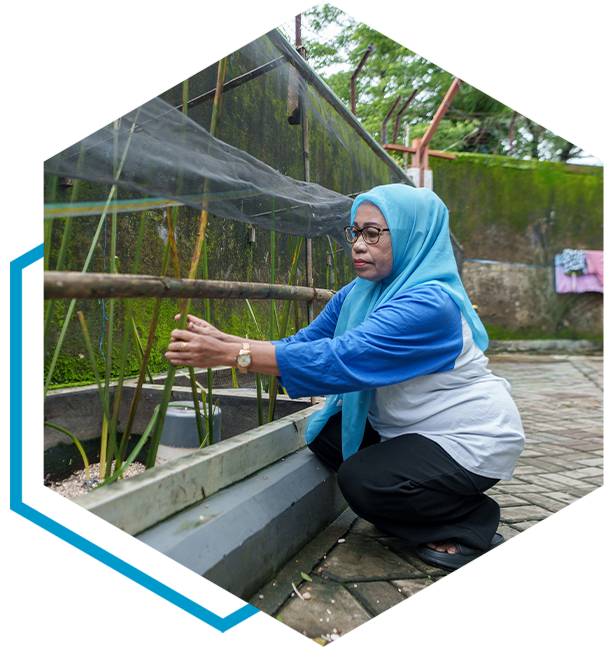
Revitalizing Informal Settlements and Environments (RISE) was created to address these risks. Led by Monash University and implemented in partnership with the City of Makassar, Hasanuddin University and local agencies, RISE delivers affordable, on-site water and sanitation solutions through simple, decentralized systems and community-driven design. The project transforms the physical and social conditions of informal settlements through improvements such as water purifying wetlands, rainwater harvesting, elevated walkways and safe public spaces.
At the core of RISE is a nature-based, water-sensitive approach that combines interventions like decentralized sanitation, climate-adaptive drainage, rainwater harvesting and wastewater treatment, designed and adapted for each neighborhood. These integrated systems clean water, reduce flood risk and improve urban conditions while functioning within the tight spatial constraints of informal neighborhoods. Raised pathways and improved drainage also enhance everyday access to and from neighborhoods, particularly during heavy rains.
Community engagement and co-design are central to the project’s success. Residents work alongside designers and city officials to identify priorities, map contamination pathways and shape solutions that respond to local needs, land tenure realities and people’s lived experiences. This process builds ownership, strengthens trust and enables communities to engage more effectively with local government.
RISE addresses sanitation alongside broader urban challenges, including public space, safety and accessibility, ensuring that infrastructure investments generate multiple benefits at once. The result is not only improved health outcomes, but stronger relationships between communities and institutions responsible for long-term service delivery.
RISE has transformed conditions across six settlements in Makassar and is shaping how the city approaches informal settlement upgrading generally. With additional sites identified locally and demonstration projects underway internationally, including six sites in Fiji, RISE shows how cities with large informal populations can improve health and resilience through inclusive, evidence-based, community-led urban transformation.
There is no prior existing relationship between the project and WRI.
By The Numbers
1,400 residents directly benefiting from new infrastructure
6,000 residents benefiting from cleaner environments and safer mobility
156 households with improved sanitation
~3,000 m² of raised accessways improving flood-safe movement
~5,000 m² of improved drainage reducing flood risk
30 additional settlements identified as priority areas